
Portland, OR
|
Organic Skincare
|
Post-Viral Revenue Recovery & Retention
Case Study Concept by Haus of Na
Not affiliated with any real brand
For illustration purposes only
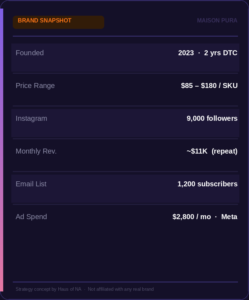
In early 2022 Sarah Okonkwo left her job to build one product she had been developing privately for three years: a mushroom adaptogen face serum - reishi, chaga, and tremella - formulated to regulate sebum, reduce redness, and strengthen the skin barrier. Retail price: $88. She sold 40 units in the first month to friends and followers, built a small but engaged Instagram following of 6,200, and was generating a steady $5,800/month by October 2023. Then, without any outreach on her part, a skincare creator with 740,000 followers posted an unboxing and 30-day result video. The video reached 2.1 million views in 72 hours. Verdure Botanics received 47,000 website sessions in four days and processed $34,200 in sales before the serum sold out completely on Day 3. Two thousand eight hundred people landed on the product page during stock-out and found nothing but an out-of-stock button. No waitlist. No capture form. Nothing. Six months after the viral moment, monthly revenue had settled back to $6,100 - barely above where it started. The spike had left almost no lasting infrastructure behind.
Verdure's problem was not acquisition - a viral moment had already proven the product could convert strangers at scale. The problem was that when 47,000 people arrived, the brand had no system to capture, retain, or ever reach any of them again.
- 47K Visitors - 312 Emails Captured:
A 0.7% email capture rate during the viral week. No pop-up, no lead magnet, no quiz, no exit-intent overlay. 46,688 warm, product-aware visitors left the site permanently. The brand had no mechanism to follow up, retarget, or re-engage any of them.
- 2,800 Stock-out Visitors - Zero Waitlist:
When inventory ran out on Day 3, there was no back-in-stock notification system. 2,800 people hit the product page, saw an out-of-stock status, and left. No email collected. No restock alert sent. That demand spike disappeared with no record and no recovery.
- 91% of Viral Buyers Never Returned:
389 customers acquired during the viral week, only 35 made a second purchase in the following six months. Post-purchase communication was a single Shopify order confirmation email. No ritual guide, no refill reminder, no follow-up sequence of any kind.
- Brand Name Becoming a Search Term - Unprotected:
After the viral video, 'Verdure Botanics serum' became a searchable term with growing monthly volume. The brand had no Google Search campaign. Competitor ads were appearing above organic results when users searched the brand name directly - intercepting intent that belonged to Verdure.
 The brief had one clear logic: the viral moment proved demand existed. The work was to build the infrastructure that captures and retains that demand the next time it arrives - and to extract value from what was already left behind.
Every decision in this strategy was shaped by one constraint: Verdure Botanics already had proof. The product had converted at scale. The brand had been seen by over two million people. The failure was entirely post-click – what happened (or didn’t happen) after someone arrived on the site, after they bought, after they left without buying. New acquisition was deprioritized. Reactivation and infrastructure came first.
Phase 1: Buyer Reactivation Before Anything Else (Week 1)
Re-engagement campaign to 389 viral-week buyers:
The most valuable audience the brand owned – people who had already paid $88, already trusted the product, and had received zero follow-up communication in six months. Contacted before any new acquisition spend.
Email 1 – ‘It’s been six months. Your skin probably noticed’:
Founder-voice email from Sarah directly. No promotion. Acknowledged the stock-out, shared a formulation update, and included a behind-the-scenes look at the next production batch. Open rate target: 55%+. This audience is warm and the brand has genuine novelty – a founder they watched go viral.
Email 2 – ‘Your restock access, before anyone else’:
Early access to next batch with a fixed window. No public announcement until the list has 48 hours. Creates real scarcity without manufactured urgency. Target: 22% re-purchase rate from this segment = approx. 85 orders = $7,480 in Week 1 from reactivation alone.
Why this comes first:
Spending on cold acquisition before reactivating existing buyers is one of the most common and expensive mistakes in DTC. The cost to reactivate a previous customer is 5–7× lower than the cost to acquire a new one.

Phase 2: Email Capture Architecture – 0.7% to 8%+ (Weeks 1–3)
Exit-intent overlay:
Triggered when cursor moves toward browser close. Offer: ‘The formulation notes – why mushroom adaptogens work on every skin type.’ A one-page PDF written by Sarah in her own voice. Relevant to the exact visitor the serum attracts. Not a discount.
25-second timed pop-up (returning visitors only):
Suppressed for first-time visitors to avoid interrupting initial browsing. Appears after 25 seconds on second visit. Short copy: ‘Get Sarah’s serum development journal – 3 years of formulation notes, free.’ Different offer than the exit-intent to avoid duplication.
Back-in-stock waitlist module:
Installed on the product page with a dedicated section, not a small text link. The lesson from 2,800 stock-out visitors is explicit in the brief. Any future inventory event captures email before it captures nothing. Target: zero lost stock-out visitors going forward.
Post-purchase email opt-in:
Shopify thank-you page updated with a secondary CTA – join the ‘Verdure Inner Circle’ for early access and formulation updates. Converts ~18% of buyers who don’t already have an active subscription status.
Phase 3: Google — Brand Protection + Category Search (Weeks 1–2)
Branded Search campaign (immediate priority):
‘Verdure Botanics’, ‘Verdure Botanics serum’, ‘mushroom face serum Portland’. These are high-intent, brand-aware searches that the brand was losing to competitor intercept. Estimated CPC: $0.45–$0.85. ROI is near-certain – these are people already looking for the product.
Category Search campaign:
Mushroom adaptogen face serum’, ‘reishi serum for skin’, ‘adaptogenic skincare USA’, ‘chaga serum oily skin’. Lower volume than broad beauty terms but significantly higher purchase intent and lower CPCs than Meta. Verdure’s product has a specific ingredient story that maps directly to specific search queries.
Google Shopping:
Product feed for the hero serum. Title: ‘Verdure Botanics Mushroom Adaptogen Serum – Reishi, Chaga, Tremella – 30ml’. Shopping ads capture visual intent and serve buyers already in a comparison mindset.
Budget allocation:
60% Branded Search / 25% Shopping / 15% Category Search. Branded campaign runs always – it is non-negotiable brand protection. Category and Shopping scaled based on ROAS performance in Weeks 3–6.
Phase 4: Post-Purchase Sequence + Meta Retargeting (Weeks 2–10)
6-email post-purchase sequence over 90 days:
Email 1 (Day 2) – ‘The science behind your serum’ (Sarah’s formulation notes on reishi and tremella). Email 2 (Day 14) – skin check-in + usage optimization tips. Email 3 (Day 30) – customer result spotlight (UGC from Instagram community). Email 4 (Day 55) – refill prompt: ‘At once-daily use, your serum is approximately 60% through.’ Email 5 (Day 65) – complementary routine suggestion. Email 6 (Day 80) – ‘Refer a friend’ program launch.
Why a refill prompt at Day 55 not Day 60:
At standard usage (one pump AM + PM), a 30ml serum lasts approximately 60–65 days. Sending the refill prompt 5–10 days before run-out captures the moment of renewed awareness before the customer has started looking elsewhere.
Meta retargeting – warm audiences only, no cold campaigns:
Upload viral-week visitor data (from Shopify analytics + Google Analytics export) as a Meta Custom Audience. Retarget visitors who landed during the viral window but did not purchase. This audience is 6 months old but highly product-aware – creative approach: ‘The serum that sold out in 72 hours. Back in stock.’ No cold Meta campaigns. Organic Instagram reach is sufficient for brand awareness. Meta budget is reserved entirely for retargeting with documented intent.
Week 1 Revenue
Reactivation email
alone, Day 1-7
Email Capture Rate
From 0.7% baseline
post-infrastructure
Repeat Rate
Viral-week buyers
via post-purch. seq.
Projected Revenue
90-day window
all channels
Verdure Botanics is not a brand that failed to grow – it’s a brand that grew unexpectedly and had no system in place to hold onto what that growth created. The 47,000 visitors, the 2,800 stock-out sessions, the 389 buyers who never heard from the brand again: these are not marketing failures, they are infrastructure failures.
The strategy doesn’t require new creative, a larger ad budget, or a new product. It requires building the capture and retention layer that should have existed before the viral moment arrived.
The $7,480 in Week 1 reactivation revenue comes entirely from an email list of 389 people, demonstrating that the highest-return work in this brand’s immediate future is not acquisition, it is making the existing asset base finally do its job.
When the next viral moment arrives for a product with this level of organic word-of-mouth, the infrastructure will be ready. Every visitor will be captured. Every buyer will enter an automated sequence. Every stock-out will build a waitlist rather than lose a customer.